Foundation Warning Signs
The early signs of foundation movement are easy to explain away one at a time. Arlington Foundation Repairs sets out what to look for around an Arlington house, in roughly the order homeowners notice it.
- Referral Service
- Slab & Pier and Beam
- Residential & Commercial
By Arlington Foundation Repairs · Updated September 2026
The Door That Started Sticking
Almost nobody calls about a foundation first. They call about a door. A door that closed cleanly for fifteen years and now has to be pushed at the top corner is telling you the frame is no longer square, and frames go out of square when the structure under them moves. The same goes for a window that suddenly needs both hands, or a door that drifts open on its own because the floor has tilted a fraction.
Timing is part of the clue. If the sticking appears in late summer and eases off after a wet spell, that is the clay under the house shrinking in the heat and swelling again with rain. Seasonal movement is normal in North Texas. What matters is whether the door comes back or whether each summer leaves it a little worse than the one before.
Cracks in the Brick
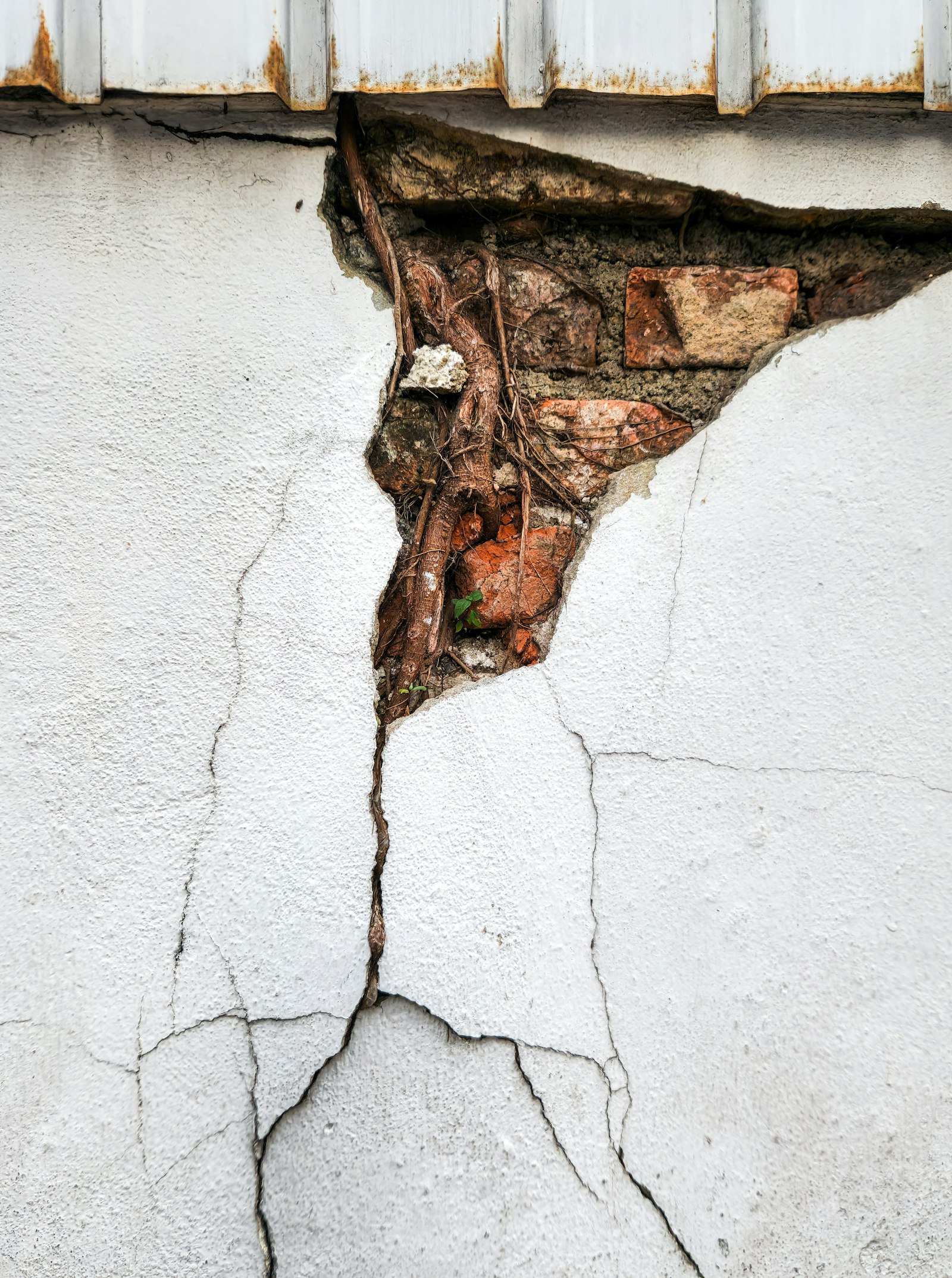
Outside, the thing to look for is a stair-step crack: one that follows the mortar joints up the wall in a staircase pattern. It usually opens wider at the top than the bottom, and that difference tells you which end of the wall is dropping. A hairline you can barely get a fingernail into is one thing. A gap you could slide a credit card through, running most of the height of a wall, is another.
Inside, look at the corners of door and window openings. Those corners are the weak points in a wall, so a wall being stretched cracks there first, usually at roughly forty-five degrees. A crack running straight across a ceiling and continuing down a wall is worth reporting too. Fine surface crazing in paint or a hairline at a drywall joint is far more often shrinkage or a bad tape job than anything structural.
Floors That Do Not Sit Right
Floors move in ways people feel before they see. A room where the furniture rocks, a marble that always rolls the same direction, tile that has cracked in a line rather than at a single point, or a floor that gives underfoot in one spot on a house over a crawl space. The old trick of rolling a ball across the room is crude but it does pick up the direction of the slope, which is useful information to give over the phone.
What none of this tells you is how much. That takes an elevation survey, where readings are taken across the whole floor and turned into numbers. Plenty of houses feel sloped and measure fine. Plenty measure worse than they feel.
Gaps Where Things Meet
Look at the joins. Separation where the brick meets a window frame, a gap opening between the baseboard and the floor, trim pulling away from the wall at one end of a room, or a strip of daylight under an exterior door that was not there before. These all say that two parts of the house are moving relative to each other. Caulk covers them up, which is why an old bead of caulk that has split down the middle is itself a sign.
Outside the House
Walk the perimeter after rain. Water standing beside the slab for more than a day, a flowerbed that stays soaked while the lawn dries out, a downspout emptying at a corner, or soil that has pulled visibly away from the slab edge in August are all causes rather than symptoms, and dealing with them is usually cheaper than dealing with what they lead to. Note any large tree within about twenty feet of a wall. A mature oak draws a great deal of moisture out of clay in a dry summer.
Signs in Arlington Houses
Most of Arlington sits on Eagle Ford and Blackland clay, with sandier Woodbine soils in parts of the north of the city, and that clay has been expanding and contracting under these houses for decades. Slabs poured in the 1950s through the 1970s around the older central and northern neighborhoods have been through more of those cycles than anything built since, and they were poured to lighter standards. Newer subdivisions in the south of the city are not exempt either, especially where building pads were cut and filled. In the smaller towns nearby the pattern repeats with local variations, and our page on foundation repair in Pantego describes what that consistent 1960s and 70s housing typically shows.
What Not to Do
Do not patch the cracks before someone has looked at them. Do not pack soil or foam into a gap under the slab edge. And do not put a jack under any part of the house yourself. Lifting a structure is done in small increments with the load properly supported, and a jack that slips under that kind of weight causes serious injuries. Photographs, a tape measure and notes with dates are the useful homeowner tools here.
Arrange an Inspection
If two or three of these signs apply to your house, and particularly if they are getting worse year on year, it is worth having the floor measured. A foundation inspection gives you elevation readings and a plain explanation, and often the answer is that nothing needs doing yet. If it does, you can read about slab repair, compare the two main pier types, or just get in touch and describe what you are seeing.